
 May 8, 2026
 May 8, 2026
By: Linda L. Goodman
Affiliate email can be a growth engine or a litigation pipeline. By tapping independent publishers, advertisers can scale campaigns quickly, test new offers, and reach audiences they’d never build on their own.
At the same time, courts have made one thing clear: when an affiliate email is challenged as deceptive or unlawful, the brand advertiser is often pulled into the dispute, even if it never touched the send button. In several high‑profile cases, advertisers found themselves defending campaigns they did not draft, did not deploy, and thought were fully “outsourced” to affiliate partners.
The safest path is not to wait for complaints and subpoenas it is to bake compliance into your approval process for every affiliate email campaign. The checklist below outlines ten questions that should be answered before you say “yes” to an affiliate send.
1. Who Is the Actual Sender of the Email?
Before you approve any campaign, you need a precise answer to a deceptively simple question: who will actually be sending the email?
Affiliate ecosystems often include:
-
Primary publishers.
-
Sub‑affiliates.
-
List managers and “mailers” who never appear in your direct contract.
Without clear visibility into the sending entity, you may not know who controls the infrastructure, which list is being used, or where complaints will land.
California courts have repeatedly emphasized sender transparency, including in Balsam v. Trancos, Inc., where the court examined whether recipients could reasonably identify the sender behind the email.
✔ CLIClaw Compliance checkpoint: Confirm the legal and operational identity of the publisher that will press send, and verify that the “from” name and sender information in the campaign clearly reflect that entity rather than a generic label.
2. Are the Sending Domains Traceable?
Technical infrastructure is often the first place plaintiffs and regulators look when building a case.
Domains that are:
-
Registered through proxy or privacy services,
-
Owned by shell entities, and
-
Spun up and abandoned quickly,
can all raise questions about whether the sender’s identity is being intentionally obscured. Courts view this type of opacity with suspicion, particularly when combined with aggressive offers or high complaint volumes.
✔ CLIClaw Compliance checkpoint: Review WHOIS or equivalent registration data for sending domains and confirm they can be traced to a legitimate business associated with the publisher or platform not to unidentifiable individuals or throwaway entities.
3. Does the Subject Line Accurately Reflect the Email?
Subject lines are the sharp edge of email marketing and often the sharp edge of litigation.
Courts assessing subject‑line claims ask whether the language creates a misleading impression about:
-
The nature of the offer.
-
The urgency (“last chance,” “ending tonight”).
-
The type of message (account notice vs. promotion).
In Rosolowski v. Guthy‑Renker LLC, plaintiffs challenged subject lines and headers under California’s anti‑spam law, arguing they created a materially misleading impression.
✔ CLIClaw Compliance checkpoint: Review subject lines to confirm they accurately describe the content and promotional nature of the email, and avoid exaggerated urgency or pseudo‑transactional framing that doesn’t match the actual message.
4. Has the Advertiser Reviewed the Creative?
Allowing affiliates to build their own creatives can speed up testing and scale, but it also increases the chance that messaging drifts away from your actual offer or your risk tolerance.
At a minimum, advertisers should review:
-
Subject lines.
-
“From” names and sender descriptions.
-
Key offer claims and pricing language.
-
How the landing page presents the same offer.
If you can’t see how your brand and offer are being presented, you can’t credibly manage the risk.
✔ CLIClaw Compliance checkpoint: Require at least a light‑touch review and approval for core creative elements in any email promoting your brand even when campaigns are launched by affiliates.
5. Are the Offer Claims Accurate?
Marketing emails often promise:
-
“Limited‑time” discounts.
-
“Exclusive” deals.
-
“Special” pricing or bonuses.
These claims must match what consumers actually receive. Courts have increasingly scrutinized situations where subject lines or body copy create expectations (e.g., steep discounts, expiring offers, exclusive access) that the real offer does not deliver.
✔ CLIClaw Compliance checkpoint: Verify that all promotional claims pricing, scarcity, bonuses, guarantees – are accurate and consistent across the email, landing page, and actual fulfillment of the offer.
6. Are Sub‑Affiliates Being Used?
Many publishers don’t mail your campaigns themselves they route them through sub‑affiliate networks or additional list owners.
This structure can:
-
Multiply the number of entities involved.
-
Reduce your visibility into who is actually sending.
-
Make it harder to stop a non‑compliant campaign quickly.
Without disclosure of sub‑affiliate relationships, an advertiser may underestimate both the scope of a campaign and the associated risk.
✔ CLIClaw Compliance checkpoint: Require full disclosure of any sub‑affiliate or downstream mailer involved in the campaign, and reserve the right to veto or restrict sub‑affiliate use for your offers.
7. Does the Campaign Clearly Identify the Advertiser?
Even when a publisher sends the email, recipients should not have to guess which advertiser’s offer they are seeing.
Clear identification of the advertiser:
-
Reduces the perception that the email is deceptive or “shadowy”.
-
Helps align with case law focusing on transparency around sender and advertiser identity.
-
Makes it easier to address complaints and unsubscribes effectively.
✔ CLIClaw Compliance checkpoint: Ensure the advertiser’s brand or corporate identity is plainly visible in the body of the email and, where appropriate, reflected in the “from” line or pre‑header text.
8. Is the Campaign Consistent With State Spam Laws?
Many teams treat CAN‑SPAM as the beginning and end of email compliance, but some of the most expensive cases arise under state law.
California, in particular, has been central to affiliate email litigation. In Hypertouch, Inc. v. ValueClick, Inc., the court allowed claims involving affiliate campaigns to proceed under the state’s anti‑spam statute, underscoring that advertisers and networks can be liable even when affiliates send the emails.
Other states (e.g., Washington) also scrutinize misleading subject lines and headers in ways that exceed basic federal requirements.
✔ CLIClaw Compliance checkpoint: Confirm that campaigns are designed to comply with both federal CAN‑SPAM and the more restrictive state anti‑spam regimes that are likely to apply, especially where large numbers of California residents are on the list.
9. Does the Affiliate Program Include Active Oversight?
Courts don’t just ask what your contracts say they ask what you actually did.
Programs that rely solely on:
-
Publisher certifications,
-
Boilerplate indemnification language, and
-
High‑level “follow all laws” clauses,
often struggle to demonstrate meaningful oversight when challenged.
Effective oversight typically includes:
-
Monitoring complaint rates and spam reports by publisher.
-
Reviewing samples of live creative and subject lines.
-
Flagging suspicious patterns in performance or deliverability.
✔ CLIClaw Compliance checkpoint: Implement documented monitoring systems that track campaign behavior over time performance, complaints, and compliance issues and show that you intervene when problems emerge.
10. Is There a Rapid Response Process for Non‑Compliant Publishers?
Even mature programs encounter issues: a rogue affiliate, a mis‑coded list, a subject line that goes too far. What matters in litigation and regulatory examinations is often less that a problem occurred, and more how quickly and decisively you responded when you became aware of it.
A strong response framework includes:
-
Clear triggers for pausing campaigns or specific publishers.
-
Escalation paths from warning to suspension to termination.
-
Internal communication protocols so legal, marketing, and compliance move in sync.
✔ CLIClaw Compliance checkpoint: Create and document a rapid response playbook for non‑compliant campaigns, including authority to suspend or terminate publishers and steps to remediate impacted recipients.
Building a Stronger Affiliate Compliance Program.
Affiliate email marketing is not going away; it remains a powerful way to drive leads and revenue. But the legal and reputational risks are real, particularly in jurisdictions that have focused on sender identity, subject lines, and affiliate relationships.
Advertisers that front‑load these ten questions into their campaign approval process are far better positioned to:
-
Detect high‑risk campaigns before they launch.
-
Demonstrate good‑faith oversight if challenged.
-
Protect brand equity while still capturing the upside of performance marketing.
By building a structured review process around sender identity, domain traceability, subject‑line and creative accuracy, state‑law compliance, and ongoing publisher oversight, companies can significantly reduce the likelihood that an affiliate email campaign will become the next test case in spam litigation.
DOWNLOAD YOUR CHECKLIST TODAY.
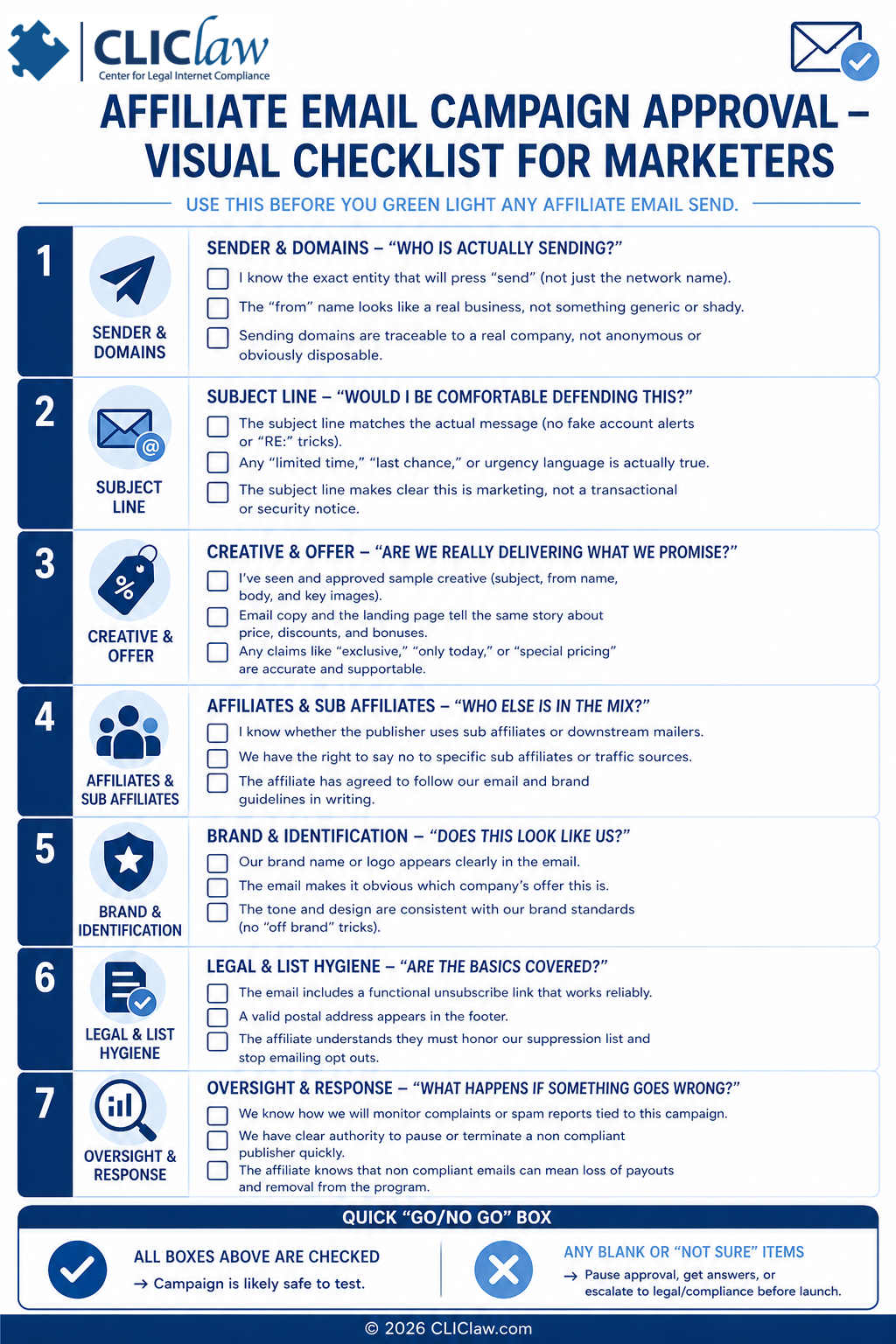
For deeper frameworks, sample policies, and playbooks you can adapt to your own program, your team can look to CLIClaw’s resources on affiliate oversight and digital marketing compliance.
© 2026 CLIClaw.com
This article is for information purposes only. It is not intended to be and should not be relied on as legal advice for any particular matter.