
 June 30, 2026
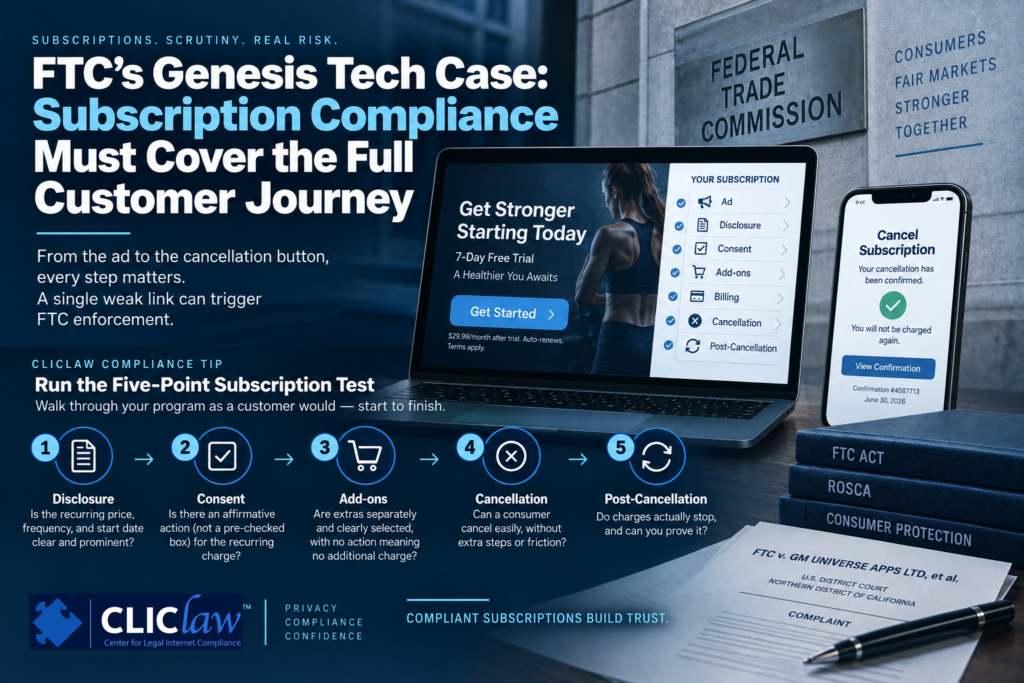
A subscription program can look compliant at checkout while creating risk everywhere else in the customer journey — the ad, the fine print, the upsell, the cancellation button, and what happens after cancellation. That’s the lesson from FTC v. GM Universe Apps LTD, et al., filed in the U.S. District Court for the Northern District of California.
What Happened.
On June 17, 2026, the FTC announced a lawsuit against 15 companies and 8 individuals it calls the “Genesis Tech enterprise,” covering apps like MadMuscles, Harna, Unimeal, Wisey, PDF Guru, PDF Master, Lumi, and Nebula. Five of these products allegedly generated nearly $250 million in revenue between early 2023 and mid-2025.
The FTC alleges three core violations of the FTC Act and ROSCA (the Restore Online Shoppers’ Confidence Act):
-
Undisclosed terms — products advertised as free or low-cost while recurring charges were buried in the smallest print on the page.
-
Unauthorized charges — consumers charged for add-on products they never knowingly selected, or double-charged for the same product.
-
Broken cancellation — cancellation options omitted from sites and apps, or charges continuing even after cancellation was “confirmed”.
The FTC also alleges the enterprise repeatedly opened new corporate entities and merchant accounts as fraud-monitoring scrutiny increased, routing revenue through Cyprus and Delaware shell companies. The case remains pending, with a court-ordered asset freeze and preliminary injunctions entered in July 2026; the allegations have not been finally adjudicated.
The Compliance Lesson.
Subscription compliance isn’t one disclosure at checkout — it’s a connected system spanning advertising, consent, billing, cancellation, and payment processing. A disclosure buried in small print, a pre-selected add-on, or a cancellation that doesn’t actually stop billing are all separate points of failure that can each trigger liability.
CLIClaw Compliance Tip: Run the Five-Point Subscription Test.
To check your own subscription program, walk through it as a customer would — start to finish:
-
Disclosure — Does the recurring price, frequency, and start date appear in text as prominent as the “get started” price and button, not just in small print below the fold?
-
Consent — Does the consumer take an affirmative action (like checking a box) specifically for the recurring charge, rather than a pre-checked default?
-
Add-ons — Is every extra product or upsell separately and clearly selected, with “no action” always meaning “no additional charge”?
-
Cancellation — Can a consumer find and complete cancellation without extra steps, explanations, or friction beyond what signup required?
-
Post-cancellation — After cancellation is confirmed, does your billing system actually stop future charges, and can you prove it (documentation, timestamps, confirmation records)?
Test this on both desktop and mobile — a compliant checkout on one may not be compliant on the other. If your business runs subscriptions, trials, or recurring billing of any kind, treat this five-point check as a standing item in your compliance calendar, not a one-time review.
For operational guidance and structured compliance documentation tools, visit the CLIClaw Marketing Compliance Library.
© 2026 CLIClaw.com
This article is for information purposes only. It is not intended to be and should not be relied on as legal advice for any particular matter.