
 May 1, 2026
By: Linda Goodman
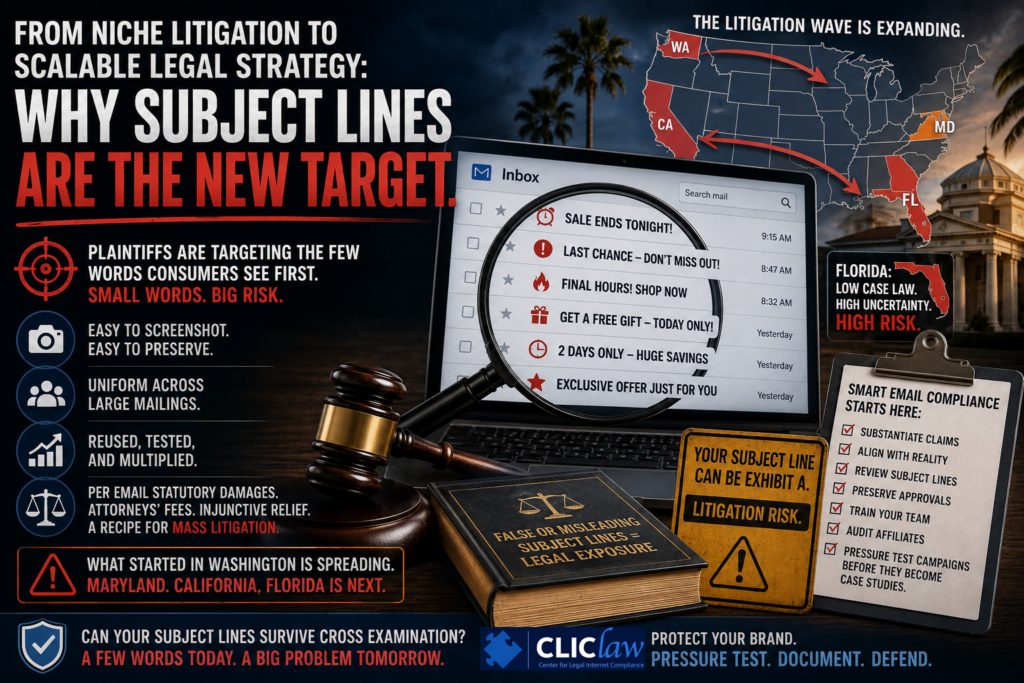
Over the past year, plaintiffs’ firms have quietly refined a very specific, and highly scalable theory of liability in email marketing: the subject line itself is the violation.
Not the body copy.
Not the landing page.
Not the full funnel.
Just the few words a consumer sees in their inbox.
That is not an accident; it is a strategy. Subject lines are:
-
Easy to screenshot and preserve.
-
Uniform across large mailings.
-
Reused and A/B tested across campaigns.
Which makes them ideal raw material for claims that can be multiplied across thousands or millions of sends. What started as a wave of filings in Washington has spread to Maryland and California, and now, Florida is emerging as the next logical frontier.
Why Florida Changes the Risk Equation.
Florida’s Electronic Mail Communications Act (“FEMCA”) has been on the books for years, mostly in the background of compliance conversations. Many marketing and legal teams have never meaningfully evaluated it.
That is about to change.
FEMCA includes familiar but powerful language prohibiting “false or misleading” subject lines, paired with enforcement tools that make it especially attractive to plaintiffs:
-
Statutory damages on a per‑email basis.
-
Attorneys’ fees.
-
Injunctive relief.
-
A relatively long lookback period.
In other words, the same structural building blocks that made Washington attractive for subject‑line litigation are present in Florida as well.
What makes Florida particularly unpredictable is the lack of modern case law applying these provisions to real‑world marketing campaigns. There is very little guidance on where courts will draw the line between aggressive subject‑line strategy and “false or misleading” content.
That means the first few cases are going to define the boundaries and until then, companies are operating in a legal gray zone.
The First Shots: What the New Cases Are Actually Attacking.
These emerging lawsuits are not aimed at obvious scams. They are aimed at mainstream marketing tactics that many brands would consider standard practice.
A recent case focuses on a familiar promotional pattern:
-
A subject line promising a “free” gift.
-
A requirement that the consumer make a purchase to receive it.
From a marketing perspective, this is a classic incentive model. From a litigation perspective, plaintiffs frame it very differently:
-
If the “free” benefit is conditioned on a purchase, the subject line may be misleading on its face.
Crucially, the claim does not hinge on whether:
-
The terms are spelled out in the email body.
-
The landing page includes full explanations.
-
Consumers eventually understand the offer after they click.
Instead, the analysis zooms in on the initial impression in the inbox. If that first impression is misleading, plaintiffs argue the statutory violation is complete the moment the email is opened or even just received.
That is a structural shift many marketing teams have not built into their review process.
The Psychology Argument: How “Clickbait” Becomes Evidence.
Another notable development is how plaintiffs describe marketing tactics themselves. Subject lines are no longer evaluated purely as binary true/false statements. They are being framed through the lens of consumer psychology.
Terms and concepts that once belonged mostly in marketing decks such as:
-
“Clickbait”.
-
Artificial urgency.
-
Behavioral nudging.
are now showing up in complaints as evidence that a subject line was designed to create a misleading perception, even if it might be technically accurate in a broader context.
This matters because it broadens what can be attacked. It’s not just about explicit falsity anymore. It’s about whether the message creates a perception that does not fully align with reality especially about:
-
How “free” an offer really is.
-
How urgent a deadline actually is.
-
How unique or exclusive a promotion truly may be.
Subject lines that were once praised internally for “driving opens” can look very different when a lawyer describes them to a court using behavioral‑economics vocabulary.
Why “We Explain It in the Email” No Longer Works.
Inside many organizations, the intuitive defense goes like this:
“Yes, the subject line is aggressive, but we explain everything clearly in the email and on the landing page.”
That argument is losing traction. Courts and plaintiffs are increasingly embracing a much sharper view: the subject line must stand on its own.
If a consumer is induced to open an email based on a misleading subject line, the statute may already have been violated regardless of what the body copy or landing page later clarify.
That creates a structural challenge for marketers because high‑performing subject lines are often intentionally designed to:
-
Spark curiosity.
-
Compress or simplify complex offers.
-
Create urgency that pushes action.
Under scrutiny, those same qualities can be reframed as misleading inducements.
The Real Exposure: It’s Not One Email, It’s All of Them.
Looked at in isolation, one problematic subject line might feel like a minor issue. That is not how plaintiffs’ firms or spreadsheets see it.
The litigation math is simple:
-
One subject line.
-
Sent to thousands (or millions) of recipients.
-
Multiplied by statutory damages per email.
Suddenly, a single campaign becomes a large, scalable damages model.
This is what makes subject‑line litigation so potent: it turns a narrow complaint into a volume‑based claim with predictable inputs and potentially high leverage in settlement discussions.
✔ CLIClaw Tip: Subject Lines Are Now Legal Content.
Most companies still treat subject lines purely as a creative exercise. They are not.
They are independent legal representations that courts are willing to evaluate separately from the rest of your campaign. In practice, that means subject lines now deserve:
-
The same level of review as disclaimers and fine print.
-
The same level of substantiation as major advertising claims.
-
The same consistency controls as core brand messaging.
If your compliance process starts after the email is drafted or never meaningfully touches subject lines then you’re already behind where litigation is going.
The Broader Trend: Plaintiffs Are Expanding the Map.
Florida is unlikely to be the end of this story. More than 30 states have some form of commercial email or anti‑spam statute on the books, many using similar “false or misleading” language. For years, those laws sat largely dormant.
Now they are being rediscovered and tested. The emerging pattern is straightforward:
-
Identify a statute with favorable damages and fee provisions.
-
Develop a repeatable theory subject lines as standalone violations.
-
File multiple cases to build pressure and shape early precedent.
-
Replicate the model in additional jurisdictions.
Florida fits this template almost perfectly. Other states can too.
What This Means for Marketers and Compliance Teams.
The takeaway is not that email marketing has become untenable. It’s that the margin for error has narrowed especially in subject lines.
Practices that once felt routine now require closer scrutiny when subject lines:
-
Promote “free” offers that are actually conditional.
-
Promise urgency or scarcity that doesn’t match actual availability.
-
Imply relationships, benefits, or exclusivity that are more nuanced in reality.
-
Oversimplify complex offers in ways that could be interpreted as incomplete or misleading.
The goal is not to eliminate curiosity, urgency, or incentives. It is to ensure those tactics can survive being evaluated in isolation, without context, and at scale across the full send list.
The Bottom Line: Can Your Subject Lines Survive Cross‑Examination?
Email litigation is evolving from blunt‑instrument spam cases to precision‑targeted claims that focus on how modern marketing really works.
Florida’s entry into this area is not just another state law to add to your chart; it’s a signal that:
-
More jurisdictions are coming into play.
-
More “normal” marketing tactics are being reframed as deceptive.
-
More brands will find themselves defending campaigns they believed were safe.
The question is no longer only whether your campaigns perform.
It is whether they can withstand being examined, one subject line at a time.
Pressure‑Test Before It Becomes a Case Study.
At CLIClaw, the focus is on helping companies evaluate email programs through the same lens plaintiffs and regulators are adopting:
-
How subject lines function as standalone legal representations.
-
How individual campaigns scale risk across entire distributions.
-
How overlapping state statutes (Florida, Washington, California and beyond) create multi‑jurisdiction exposure.
In today’s environment, the difference between a high‑performing campaign and a high‑risk one often comes down to just a few words in the subject line. Pressure‑testing those words now is far less expensive than seeing them again later quoted in a complaint.
Visit our CLIClaw Email Marketing Compliance Program for compliance training, risk assessments, and practical legal guidance designed specifically for the digital marketing industry.
© 2026 CLIClaw.com
This article is for information purposes only. It is not intended to be and should not be relied on as legal advice for any particular matter.