
 August 20, 2026
Connecticut has enacted a wide-ranging law addressing artificial intelligence, automated employment decisions, and online protections for minors.
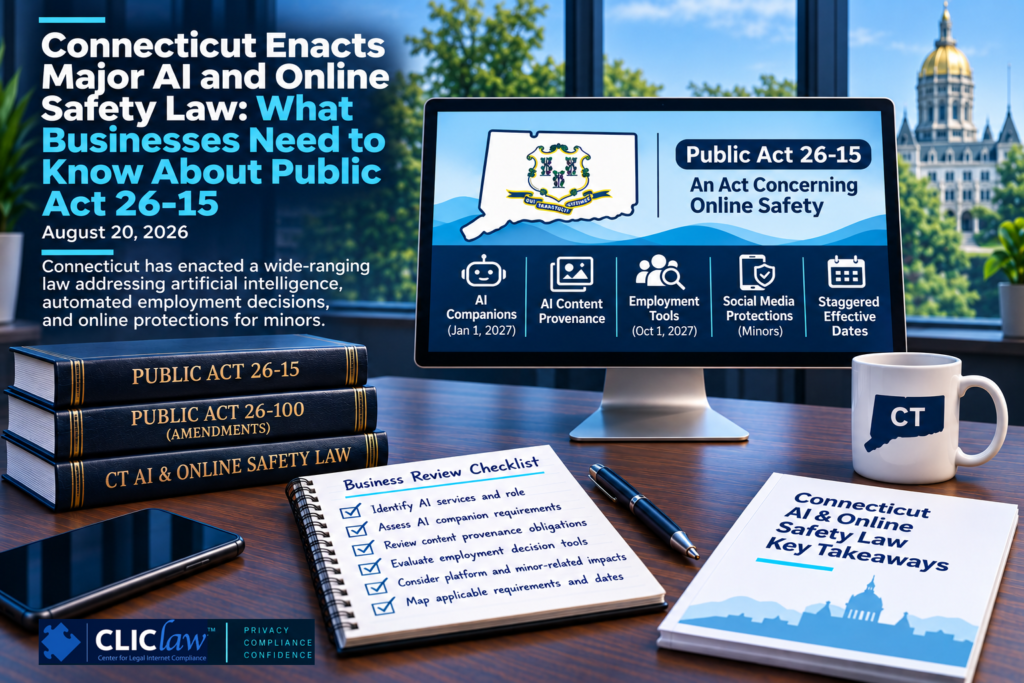
Public Act 26-15, An Act Concerning Online Safety, establishes different requirements for different technologies and business activities. Its provisions have staggered effective dates, so businesses should not assume that every requirement applies to every AI user, or begins at the same time.
For online businesses and marketing teams, the starting point is understanding which activities the law regulates.
AI Services Face Different Requirements.
The law addresses AI companions, certain generative-AI providers, and frontier-model developers separately. Simply using a commercial AI writing or image-generation tool does not place a business in every regulated category.
AI-companion operators face disclosure and safety requirements, including measures addressing self-harm and additional protections involving minors. These provisions are scheduled to take effect January 1, 2027. Businesses offering conversational products should examine whether their service meets the companion definition rather than rely on its product name.
AI Content Rules Matter – but Their Scope Matters, Too.
The legislation includes content-provenance requirements for covered generative-AI providers. These provisions concern information that helps identify AI-generated or materially altered audio, images, and video.
For marketers, the distinction is important: using AI-generated content is not the same activity as developing a covered generative-AI service. Businesses should determine their role before assuming the provider requirements apply to their marketing operations.
Online Businesses Should Review Employment Tools.
The law also addresses automated technologies used in employment decisions.
Beginning October 1, 2027, covered employers using these technologies must provide specified notices to affected applicants and employees. The legislation also makes clear that employers cannot avoid discrimination liability by attributing a decision to an automated system.
Online businesses and agencies should therefore identify tools used to screen applicants, rank candidates, or influence other employment decisions, including technology embedded in third-party HR platforms.
Social Media Protections Focus on Platforms.
The law establishes protections involving minors’ access to algorithmic feeds, parental permission, notifications, and default settings. These provisions primarily concern covered social media platforms, not every business advertising on them.
For marketers serving younger audiences, they are nevertheless a development worth monitoring as platforms prepare to change relevant features and account settings.
Read the Law Together With Its Amendments.
Connecticut also enacted Public Act 26-100, which changes portions of the AI framework, including subscription-related provisions and an independent-verification pilot program. Businesses should evaluate the amended framework rather than rely exclusively on the original PA 26-15 text.
The practical next step is a focused review: identify your AI services, employment tools, and platform activities; determine which legal categories fit; and map the applicable requirements and dates. A single generic AI policy will not answer those questions.
For operational guidance and structured compliance documentation tools, visit the CLIClaw Compliance Library.
© 2026 CLIClaw.com
This article is for information purposes only. This article provides general information and operational commentary. It is not legal advice. Applicability and compliance obligations depend on an organization’s activities, data practices, exemptions, and circumstances. It is not intended to be and should not be relied on as legal advice for any particular matter.