
 August 12, 2026
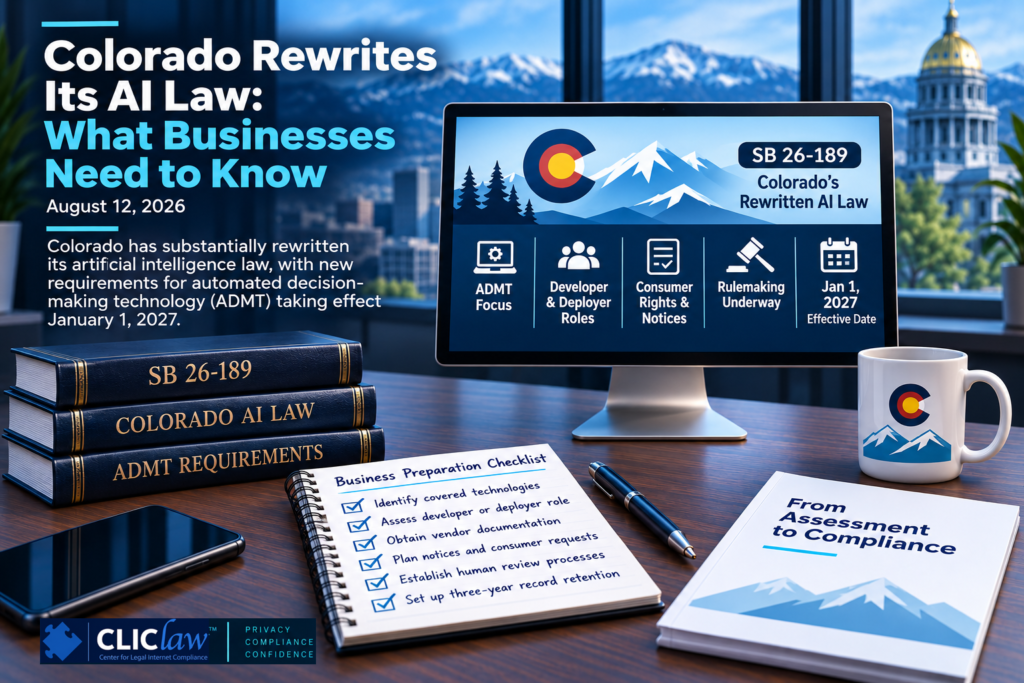
Colorado has substantially rewritten its artificial intelligence law. On May 14, 2026, Governor Jared Polis signed Senate Bill 26-189, replacing the central framework established by Colorado’s original 2024 AI legislation. The new substantive requirements are scheduled to take effect January 1, 2027.
The revised law focuses on automated decision-making technology, or ADMT, used to materially influence consequential decisions. For businesses that already began preparing for the original Colorado AI Act, this means reviewing, not simply continuing, their earlier compliance plans.
The Focus Shifts From AI Labels to Decision-Making.
The law generally addresses technology that processes personal data and produces predictions, recommendations, rankings, scores, or similar outputs used to make or assist decisions about individuals. Its central requirements apply when that technology materially influences a consequential decision.
Covered decision areas include:
-
Employment and education.
-
Housing.
-
Financial or lending services.
-
Insurance and health-care services.
-
Essential government services and public benefits.
Businesses should therefore look beyond products marketed as “AI.” A scoring or ranking tool may warrant review because of how its output affects a decision, even if the organization considers it ordinary business software. The law also includes exclusions and sector-specific provisions, so not every automated tool or workflow is covered.
Developers and Users Have Different Responsibilities.
SB 26-189 distinguishes between developers that provide covered technology and deployers that use it.
Developers must provide specified documentation about matters such as intended uses, training-data categories, known limitations, and instructions for appropriate use and human review. They must also communicate certain material updates or modifications.
Deployers must address consumer-facing requirements, including notice about covered ADMT use and additional plain-language information within 30 days after an adverse consequential decision. The law also provides applicable rights involving personal-data requests, correction of factually incorrect data, and meaningful human review and reconsideration. Both developers and deployers have compliance-record retention obligations of at least three years.
For employers, the scope deserves particular attention: employment-related decisions can be covered, making applicant screening, ranking, and other decision-support systems important review areas.
Rulemaking Is Underway.
On August 11, 2026, the Colorado Attorney General’s Office filed proposed rules addressing the ADMT law alongside Colorado’s separate chatbot legislation. As of this article’s August 12 information cutoff, those rules are proposed, not final.
Businesses should distinguish the enacted statutory requirements from proposed implementation details. Preparations can begin now, but procedures should be checked against the final rules before implementation.
Where Businesses Should Start.
A practical first step is to identify which technologies influence consequential decisions and document how their outputs are used. From there, businesses can determine their developer or deployer role, obtain relevant vendor documentation, and assign responsibility for notices, consumer requests, human review, and recordkeeping. These preparations should reflect the rewritten law rather than rely solely on the original AI Act framework.
For operational guidance and structured compliance documentation tools, visit the CLIClaw Compliance Library.
Explore the Colorado Attorney General resources here: https://coag.gov/ai/
© 2026 CLIClaw.com
This article provides general educational information and does not constitute legal advice. Final rule adoption, hearing continuation, subsequent orders, or other developments may change the appropriate analysis. Applicability depends on the governing statutes, final regulations, organizational roles, technology, and surrounding facts.