
 August 14, 2026
A federal court froze the assets of Credit Glory, a network of 17 companies the FTC accuses of scamming consumers out of nearly $200 million — and the tactics involved go well beyond credit repair, touching paid search advertising, telemarketing scripts, and recurring billing practices common across many industries.
What Happened.
The FTC’s complaint, filed August 3, 2026, in the U.S. District Court for the District of Arizona, alleges Credit Glory bought Google search ads designed to intercept consumers searching for specific creditors and debt collectors — including military lenders like USAA and the Army & Air Force Exchange Service — then routed them to telemarketers who impersonated those creditors. Once on the phone, the FTC alleges telemarketers charged a small “verification” fee (often $1), followed by a separate upfront fee typically in the hundreds of dollars, then enrolled consumers in recurring negative-option billing without express informed consent — continuing to charge some consumers indefinitely despite promising the billing would last only a few months. The complaint also alleges the operation filed false identity theft reports on consumers’ behalf, without their knowledge, in an attempt to remove negative credit information. A court entered a temporary restraining order and appointed a receiver on August 4, 2026; the case remains pending and the allegations haven’t been proven in court.
Why this Matters Beyond Credit Repair.
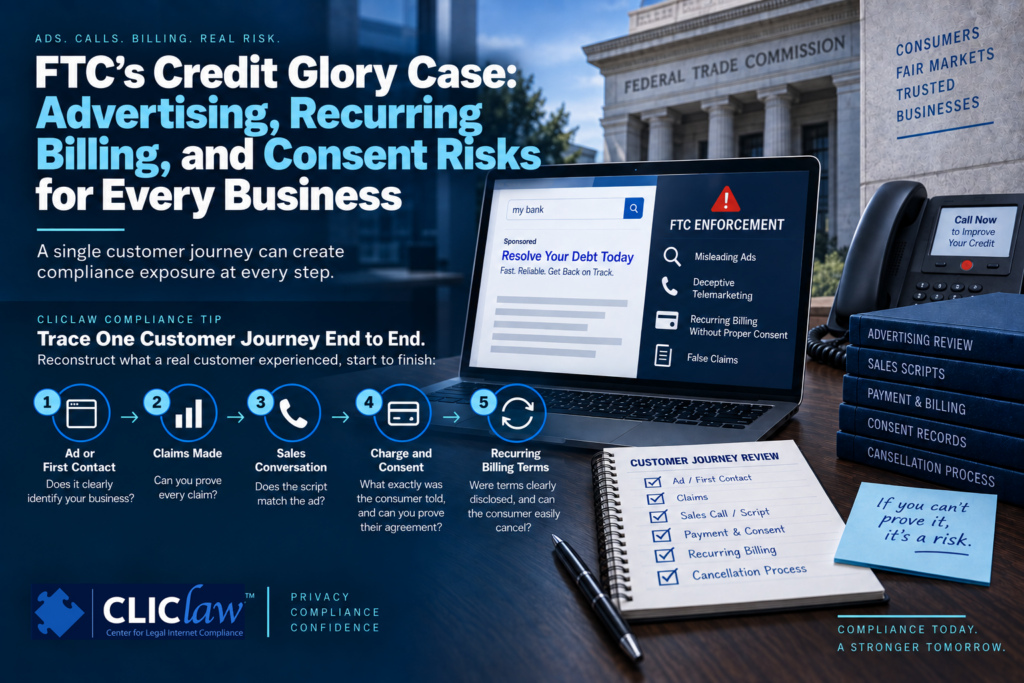
Strip away the credit-repair specifics, and this case is really about four things that apply to nearly any business using digital ads, telemarketing, or subscriptions: whether your advertising accurately identifies who you are, whether your performance claims are substantiated, whether your recurring charges are properly disclosed and authorized, and whether consent is documented rather than assumed. A single customer journey — ad, landing page, sales call, payment, recurring billing — creates compliance exposure at every step, and a gap at one stage (like an unreviewed telemarketing script) can undermine an otherwise-compliant advertisement.
CLIClaw Compliance Tip: Trace One Customer Journey End to End.
Pick a real customer who came through your highest-volume acquisition channel — paid search, affiliate, telemarketing, or direct — and reconstruct exactly what they experienced, start to finish:
-
The ad or first contact — Does it clearly identify your business, or could it be confused with another company (a competitor’s name, a well-known brand, or a service the consumer was actually searching for)?
-
The claims made — Can you produce evidence supporting every performance claim in the ad, landing page, or sales script (e.g., “improve your score,” “save 50%,” “guaranteed results”)?
-
The sales conversation — If a call center, affiliate, or sales team is involved, does their actual script match what the advertisement promised? Pull a recorded call or transcript and compare it to your approved messaging.
-
The charge and consent — What exactly was the consumer told before the first charge, and can you produce evidence of what they saw and affirmatively agreed to — not just proof that a transaction occurred?
-
The recurring billing terms — If billing continues after the first charge, was that clearly disclosed before payment, and can the consumer easily find and complete cancellation?
If you can’t produce documentation for every step of that one customer’s journey — the ad, the script, the consent record, and the cancellation path — treat that as a compliance gap to close before it becomes a regulator’s finding instead of yours.
For operational guidance and structured compliance documentation tools, visit the CLIClaw Marketing Compliance Library.
© 2026 CLIClaw.com
This article is for information purposes only. It is not intended to be and should not be relied on as legal advice for any particular matter.