
 August 1, 2026
Telling a customer a product will ship quickly isn’t just a customer-service promise — it’s a claim that can trigger federal liability if you can’t back it up. The FTC’s Trend Deploy case, which closed out in July 2026 with $672,000 in consumer refunds, shows exactly how that plays out.
What Happened.
In June 2021, the FTC sued Frank Romero, who ran Trend Deploy, alleging he advertised fast delivery of N95 masks and other PPE during the pandemic without any reasonable basis for those promises. According to the complaint, orders arrived late or never arrived, customers weren’t notified of delays, cancellation and refund requests went unhonored, and some who did receive products got lower-quality masks than what they ordered. In 2023, the U.S. District Court for the Middle District of Florida found Romero violated the FTC Act and the Mail Order Rule — not just on shipping speed, but also on claims that the masks were NIOSH- or FDA-certified and met specific filtration standards he couldn’t substantiate. The court entered a $989,483.69 judgment plus a separate civil penalty, and permanently barred Romero from selling any protective goods or services. After Romero didn’t fully pay, a 2025 court order forced him to turn over remaining bank and retirement funds, which the FTC used to mail 9,419 refund checks in July 2026.
Why this Matters for Any Online Seller.
Strip away the PPE-specific details, and this case is a roadmap for basic e-commerce liability: advertised availability and delivery times are marketing claims, not just operational estimates, and a business needs a real basis for making them. That basis breaks down in predictable ways — overselling limited inventory, relying on suppliers without confirming their capacity, or continuing to advertise “in stock” after inventory runs out. When a shipment is delayed, the law doesn’t just expect you to eventually fulfill it; it expects you to notify the customer and offer a cancellation and refund. And substituting a “similar” but lower-quality product without the customer’s consent is its own separate problem, distinct from the shipping delay itself.
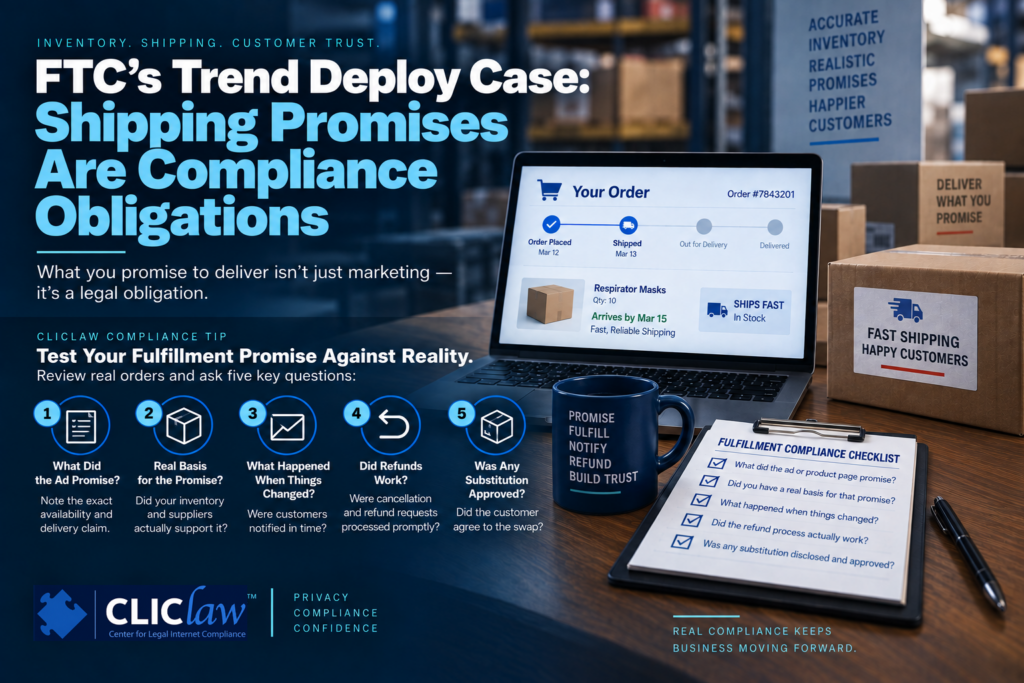
CLIClaw Compliance Tip: Test Your Fulfillment Promise Against Reality.
Pick a handful of recent orders — including at least one that shipped on time, one that was delayed, and one that was cancelled or refunded — and trace each from the customer’s point of view:
-
What did the ad or product page promise? Note the exact availability and delivery claim the customer saw (e.g., “ships today,” “in stock,” “delivered within 48 hours”).
-
Did you have a real basis for that promise? Check whether your inventory and supplier data actually supported the claim at the time it was made — not just whether it happened to work out.
-
What happened when things changed? If a shipment was delayed, was the customer notified in time to choose between waiting or cancelling for a refund? A silent delay is the compliance gap regulators look for first.
-
Did the refund process actually work? Confirm refund requests tied to delays or cancellations were processed promptly — a written refund policy means nothing if customer service can’t or won’t execute it.
-
Was any substitution disclosed and approved? If you ever ship a different product than what was ordered, make sure the customer agreed to the swap and that it doesn’t change what they were told they were buying.
Run this check before launching any high-volume promotion, flash sale, or new product drop — a marketing campaign that outpaces your fulfillment capacity is exactly how a shipping estimate turns into a federal compliance problem.
For operational guidance and structured compliance documentation tools, visit the CLIClaw Marketing Compliance Library.
© 2026 CLIClaw.com
This article is for information purposes only. It is not intended to be and should not be relied on as legal advice for any particular matter.