
 January 20, 2026
By: Linda Goodman
Email marketing remains one of the highest-ROI channels for businesses. But a recent Washington federal court decision is a timely reminder that how you write your subject lines matters just as much as what’s inside the email.
In Ma v. Nike, Inc., a Washington court allowed a class action lawsuit to proceed based on allegedly misleading promotional email subject lines – without requiring proof that anyone opened the emails, clicked a link, or made a purchase
This isn’t about spam.
It’s about accuracy, urgency, and trust – and it offers a practical lesson for every business that uses email to drive sales.
The Real Issue: Promotional Urgency Must Be Real.
The case centers on Washington’s Commercial Electronic Mail Act (“CEMA”), which prohibits sending commercial emails to Washington residents with false or misleading subject lines.
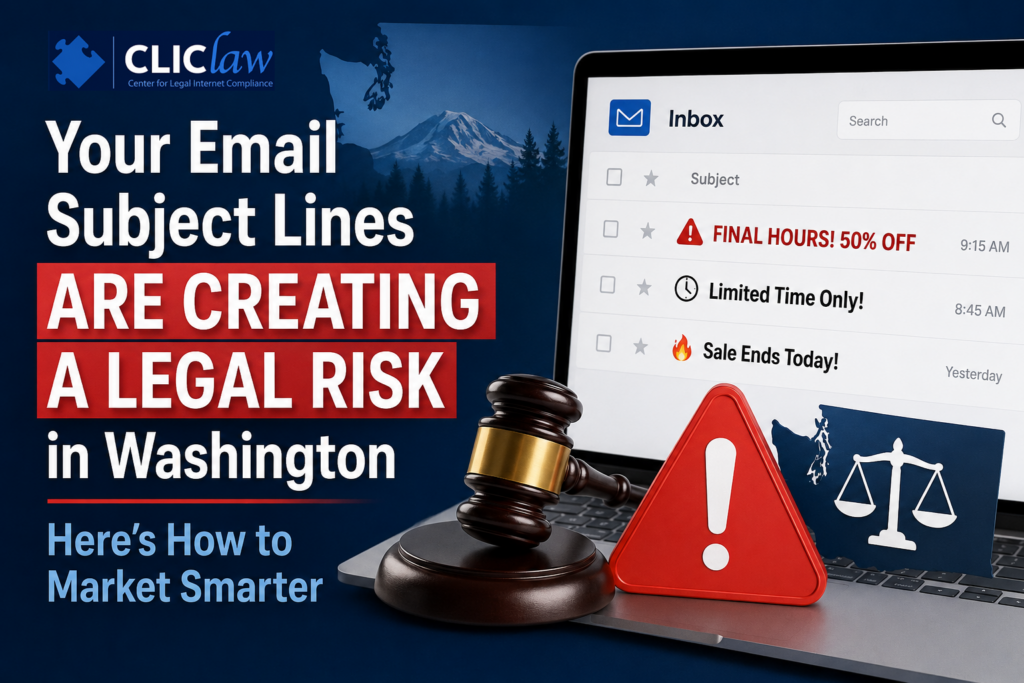
The plaintiff alleged that promotional emails advertised sales as:
-
“Ending soon”
-
“Final hours”
-
“Limited time only”
…while the same promotions were later extended or repeated.
The court ruled that these allegations were enough to move forward, even though the plaintiff did not claim:
-
He relied on the emails;
-
He bought anything; and
-
He suffered out-of-pocket loss.
Under Washington law, the subject line itself can be the violation and fines attach.
Why Washington Email Law Deserves Your Attention.
Washington’s email statute is stricter than many businesses realize:
-
It applies to any commercial email sent to a Washington resident.
-
It focuses on truthfulness, not intent.
-
A violation automatically triggers Washington’s Consumer Protection Act.
-
Plaintiffs do not need to prove reliance or damages at the pleading stage.
For national campaigns, this means one state’s rules can affect your entire email strategy.
The Answer is Not Anti-Marketing – It’s Smarter Marketing.
Let’s be clear: Washington law does not prohibit urgency-based marketing.
What it requires is simple: If you say it ends today, it should actually end today.
From a brand perspective, this aligns with best practices anyway. Artificial scarcity may create short-term clicks, but it erodes long-term trust and invites scrutiny.
Five Ways to Reduce Risk Without Killing Conversions.
Businesses don’t need to overhaul their email programs to comply. They need alignment and discipline.
Here’s where to focus:
-
Treat Subject Lines Like Advertising Claims. Subject lines are not casual copy, they’re regulated marketing statements. Review them with the same care as pricing or discount terms.
-
Match Urgency Language to Reality. If a promotion might be extended, avoid absolute phrases like “last chance” or “final hours.”
-
Coordinate Marketing and Ops. Marketing calendars should align with backend systems so promotions end when promised.
-
Avoid “Perpetual Sales” Framing. Repeated “limited-time” offers can undermine credibility, and raise compliance questions.
-
Build a Lightweight Email Compliance Check. A short pre-send review process for your marketing team can dramatically reduce legal exposure without slowing campaigns.
What Smart Businesses Are Doing Differently.
Forward-thinking companies are using compliance as a marketing advantage, not a constraint. They are:
-
Writing clearer, more accurate subject lines;
-
Building trust through consistency; and
-
Reducing class-action exposure quietly, before it becomes expensive.
That’s exactly the approach CLIClaw is designed to support.
Visit CLIClaw Email Marketing Compliance Program for compliance training, risk assessments, and practical legal guidance designed specifically for the digital marketing industry.
© 2026 CLIClaw.com
This article is for information purposes only. It is not intended to be and should not be relied on as legal advice for any particular matter.