
 May 18, 2026
By: Linda Goodman
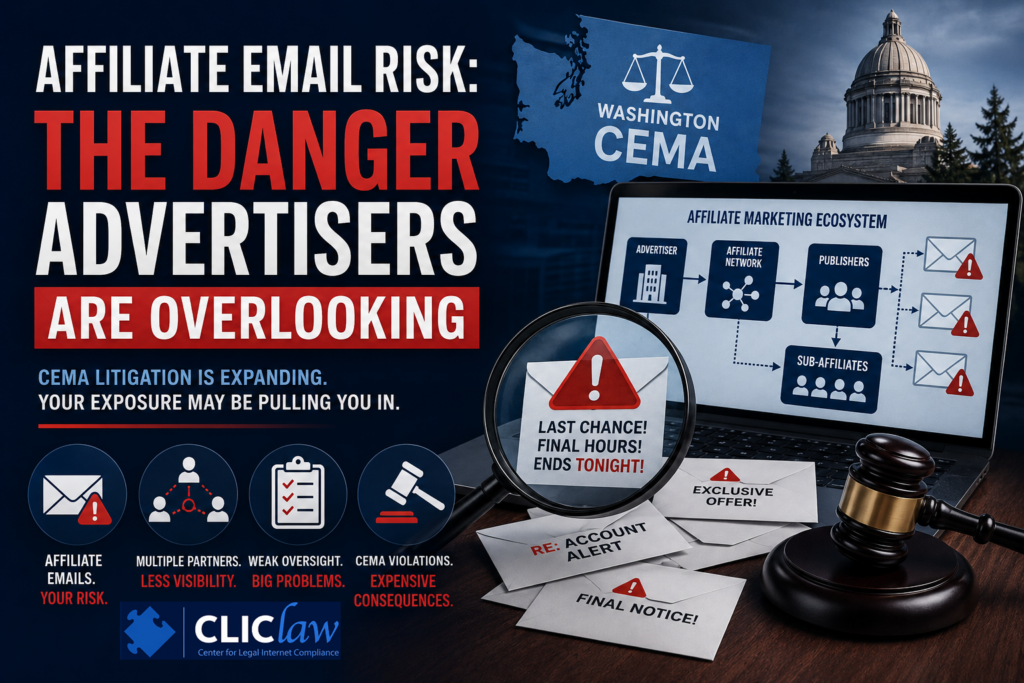
Many brands believe affiliate email risk is outsourced risk. That assumption is becoming increasingly dangerous. As Washington CEMA litigation expands, advertisers are discovering a hard reality: Plaintiffs often do not care who physically pressed “send.” They care about whose products were promoted. That distinction is creating significant exposure for brands operating affiliate, publisher, lead-generation, and performance-marketing programs…and many companies are far less protected than they think.
The Illusion of Distance.
One of the most common assumptions in affiliate marketing is: “The affiliate controls the email, so the affiliate owns the risk.” Legally, that is often far more complicated.
In Washington, an advertiser using a publisher is generally not held strictly liable for the publisher’s independent errors. However, advertisers are directly responsible for the content of their own ads. Liability depends heavily on intent, the level of control over the publisher, and specific regulatory or deceptive practices laws.
Washington’s false advertising laws generally require a showing of fault. Under that law, it is unlawful to disseminate false or misleading advertising if the person or business acts “with knowledge of the facts” that render the ad deceptive.
-
Publisher Exemption: Publishers (like newspapers, broadcasters, or web platforms) are shielded from liability if they publish the ad in “good faith without knowledge” of its deceptive character.
-
Advertiser Responsibility: Advertisers cannot hide behind a publisher if they knowingly provided the deceptive information or drafted the ad’s misleading claims.
If an advertisement is deemed an “unfair or deceptive act or practice” under the Washington Consumer Protection Act, liability generally falls on the sponsor or creator of the ad rather than the conduit publisher, provided there is proof that the advertiser’s conduct was deceptive and impacted the public.
Under the Washington Commercial Electronic Mail Act, advertisers face extremely strict rules regarding digital and email advertising. The Washington Supreme Court ruled that sending promotional messages or emails that contain any false or misleading information is a per se violation of the CPA. Statutory damages for violations can reach ($500) per message, even without a showing of actual financial harm to the recipient.
Plaintiffs Are Looking for Weak Governance.
Modern CEMA litigation increasingly targets operational weaknesses. Plaintiffs want to know:
-
Who approved the campaign?
-
Who reviewed the subject lines?
-
Were affiliates monitored?
-
Did the advertiser audit email practices?
-
Were suppression lists enforced?
-
Were deceptive templates prohibited?
-
Were affiliates allowed to modify creative?
-
Did anyone review urgency claims?
Those advertisers who operate affiliate programs with minimal real oversight beyond performance metrics will find themselves named in the quickly approaching class action complaints. That creates dangerous discovery problems. Because once litigation begins, “we trusted the affiliate” is not a strong compliance defense.
The Subject-Line Problem Gets Worse in Affiliate Marketing.
Affiliate marketing magnifies CEMA exposure because affiliates frequently:
-
Rewrite subject lines,
-
Test variations,
-
Use recycled templates,
-
Deploy aggressive urgency tactics, or
-
Prioritize open-rate performance over legal accuracy.
All without the advertiser’s knowledge or approval and many never see the final deployed version. That becomes especially dangerous when affiliates use terms like “Last Chance” “Final Notice” “Ends Tonight” “Exclusive Offer” “RE:” “Account Alert” or similar high-risk language.
As advertisers, including sophisticated advertisers often lack centralized approval systems, live monitoring, archived creative records, or documented compliance review workflows. They have placed themselves at great risk and Plaintiffs know this.
Affiliate Networks Create Additional Complexity.
Many advertisers rely on affiliate networks believing the network acts as a compliance buffer. In reality, networks may complicate visibility. Brands often cannot easily determine: (1) which publisher deployed the email; (2) which creative version was used; whether sub-affiliates participated; what subject line variations existed: or what domains were actually used.
That operational fragmentation becomes a serious problem during litigation. This is especially true when plaintiffs request: campaign records, approval logs, email copies, publisher contracts, compliance audits, and communications regarding marketing practices. The advertiser may suddenly realize it lacks the documentation necessary to defend the program effectively.
The Discovery Problem Most Brands Are Not Prepared For.
CEMA litigation is not limited to a single email screenshot. Discovery may extend into Slack messages, affiliate onboarding records, publisher questionnaires, campaign approvals, internal complaints, compliance escalations, fraud reports, and vendor communications.
Plaintiffs increasingly argue that advertisers ignored warning signs or failed to implement reasonable oversight controls. This transforms what many companies view as a “marketing issue” into a governance issue. And governance failures are difficult to explain away after the fact.
“We Have a Contract” and “We Have Indemnity” Is Not Enough.
Many advertisers assume broad contractual compliance clauses or indemnity provisions solve the problem. They usually do not. A generic requirement that affiliates comply with “all applicable laws” is rarely enough by itself. Regulators and plaintiffs increasingly expect operational compliance programs, including:
-
Onboarding procedures,
-
Publisher vetting,
-
Subject-line restrictions,
-
Campaign approval standards,
-
Audit rights,
-
Monitoring procedures,
-
Escalation processes, and
-
Documented enforcement actions.
The issue is no longer simply whether a contract exists. The issue is whether the advertiser exercised meaningful oversight.
The Hidden Risk of Sub-Affiliates.
One of the largest hidden dangers involves sub-affiliate relationships. A brand may approve an affiliate network, or a direct publisher relationship, without realizing the actual email traffic originates from downstream partners the advertiser has never vetted. That creates visibility and accountability problems immediately.
This is especially true where domains are masked, tracking infrastructure is fragmented, or campaign sourcing becomes difficult to trace. By the time litigation arrives, the advertiser may not even know who actually transmitted the email.
Why This Matters Beyond Washington.
CEMA may currently be driving the headlines, but the underlying issue is much broader. Affiliate email programs increasingly intersect with state consumer protection laws, TCPA claims, privacy statutes, deceptive marketing theories, wiretap litigation, and FTC unfairness standards. The larger regulatory trend is clear that companies are expected to actively govern their marketing ecosystems and not merely outsource risk through contracts. That expectation is only increasing.
✔ CLIClaw Compliance Takeaway.
Advertisers operating affiliate or publisher email programs should immediately evaluate:
-
Affiliate onboarding procedures,
-
Subject-line approval controls,
-
Publisher monitoring systems,
-
Creative review processes,
-
Suppression management,
-
Audit rights,
-
Sub-affiliate visibility, and
-
Documentation retention practices.
Because in today’s litigation environment, the biggest CEMA risk may not be the email your marketing department approved. It may be the one your affiliate deployed without you ever seeing it.
Visit our CLIClaw Email Marketing Compliance Program for compliance training, risk assessments, and practical legal guidance designed specifically for the digital marketing industry.
© 2026 CLIClaw.com
This article is for information purposes only. It is not intended to be and should not be relied on as legal advice for any particular matter.