
 May 4, 2026
By: Linda Goodman
Email marketers have a new litigation problem. It is not hidden tracking. It is not pixels. It is not the registration of your mailing domains. It is not consent language buried in a privacy policy.
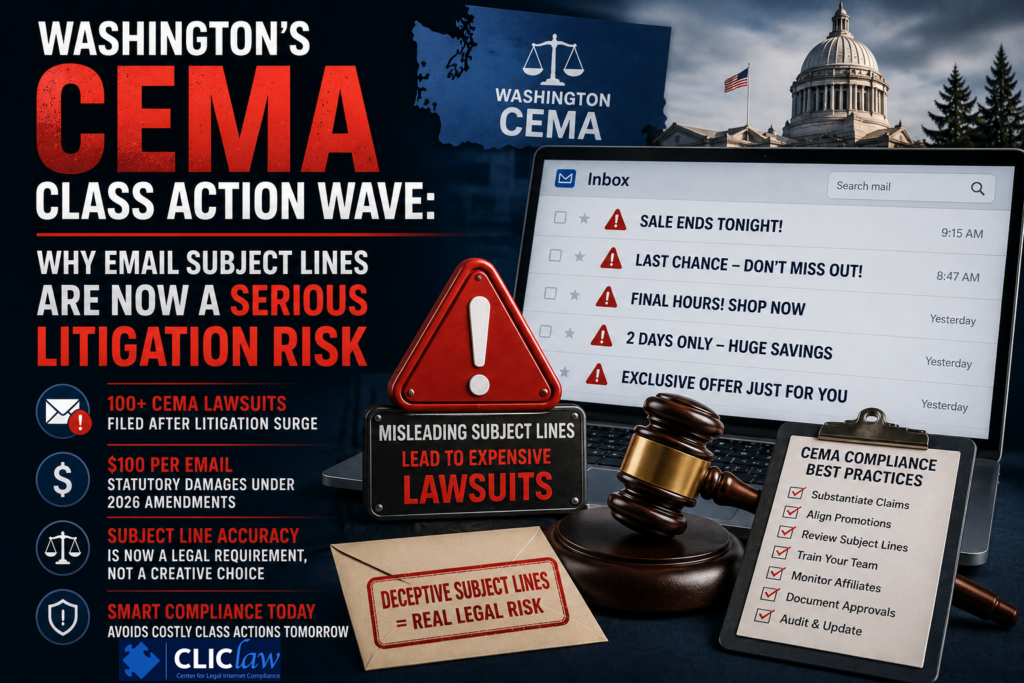
It is the subject line. Washington’s Commercial Electronic Mail Act, known as CEMA, has become one of the most active state-law weapons against routine marketing emails. After Brown v. Old Navy, the Washington Supreme Court held that CEMA can reach any false or misleading information in a commercial email subject line, not just statements that disguise the commercial nature of the message. That ruling opened the door to a wave of class actions targeting familiar promotional language: “Sale Ends Tonight,” “Last Chance,” “Final Hours,” “2 Days Only,” or similar urgency claims.
The risk is not theoretical. Reports indicate more than 100 CEMA lawsuits were filed after the litigation surge began, compared with only a handful of retailer cases in prior years.
Why CEMA Is So Dangerous for Email Marketers.
CEMA is dangerous because it turns ordinary promotional language into statutory-damages litigation. Before Washington’s 2026 amendments, CEMA allowed $500 per prohibited email, plus potential Consumer Protection Act exposure. The 2026 amendments reduced statutory damages to $100 per email and added a knowledge-based standard, but that still leaves massive class action exposure for large email campaigns. For a brand sending thousands of emails to Washington residents, the math gets ugly very quickly.
Plaintiffs’ firms are not simply complaining about spam. They are challenging marketing architecture including campaign calendars, promotional extensions, subject-line approvals, segmentation practices, and whether the business knew or should have known that a deadline or discount claim was not literally accurate.
The Problem with “Last Chance” Marketing.
Many marketing teams use urgency language reflexively. But under CEMA, urgency language can become evidence. If the subject line says a sale ends tonight, the sale should end tonight. If the subject line says “final hours,” there should not be another materially similar promotion waiting the next morning. If the subject line says “exclusive,” the offer should actually be exclusive. Plaintiffs are focusing on subject lines that allegedly create false urgency or misstate the terms, duration, availability, or exclusions of a promotion.
The body of the email may not save the campaign. Courts and plaintiffs have focused heavily on the subject line itself, and disclaimers inside the email may not cure a misleading subject line.
HB 2274 Helped But It Did Not Eliminate the Risk.
Washington enacted HB 2274 in March 2026 in response to the litigation wave. The law reduced statutory damages from $500 to $100 per prohibited email and requires actual knowledge or knowledge fairly implied from objective circumstances that the subject line was false or misleading. That is helpful. But it is not a free pass.
The statute still applies broadly to commercial emails sent to Washington residents. It still focuses on subject-line accuracy. It still creates statutory damages exposure. And it still gives plaintiffs a reason to scrutinize promotional email campaigns at scale. In other words, CEMA reform lowered the temperature. It did not put out the fire. At the class action level $100 per email is just as easy to justify as $500 an email.
The CLIClaw Compliance Takeaway.
Email subject lines now need legal-quality discipline. That does not mean every campaign needs a lawyer. It means companies need a process. At minimum, businesses sending promotional email should:
-
Require factual substantiation for urgency claims;
-
Prohibit recycled “last chance” language unless actually true;
-
Align subject lines with campaign calendars;
-
Review Washington-recipient campaigns separately where appropriate;
-
Preserve approval records;
-
Train marketing teams on CEMA risk;
-
Audit old templates and automation flows; and
-
Review affiliate and publisher email practices.
The biggest mistake is treating CEMA as a Washington-only technical problem. It is not. It is a warning sign about where email marketing litigation is heading: state-law claims, statutory damages, class actions, and aggressive scrutiny of routine promotional practices. For brands, advertisers, publishers, and agencies, the message is clear:
Your subject line is no longer just a marketing hook. It is a real litigation risk in six words.
Visit our CLIClaw Email Marketing Compliance Program for compliance training, risk assessments, and practical legal guidance designed specifically for the digital marketing industry.
© 2026 CLIClaw.com
This article is for information purposes only. It is not intended to be and should not be relied on as legal advice for any particular matter.